Foundry — Ignium-Request Hysteresis Circuit
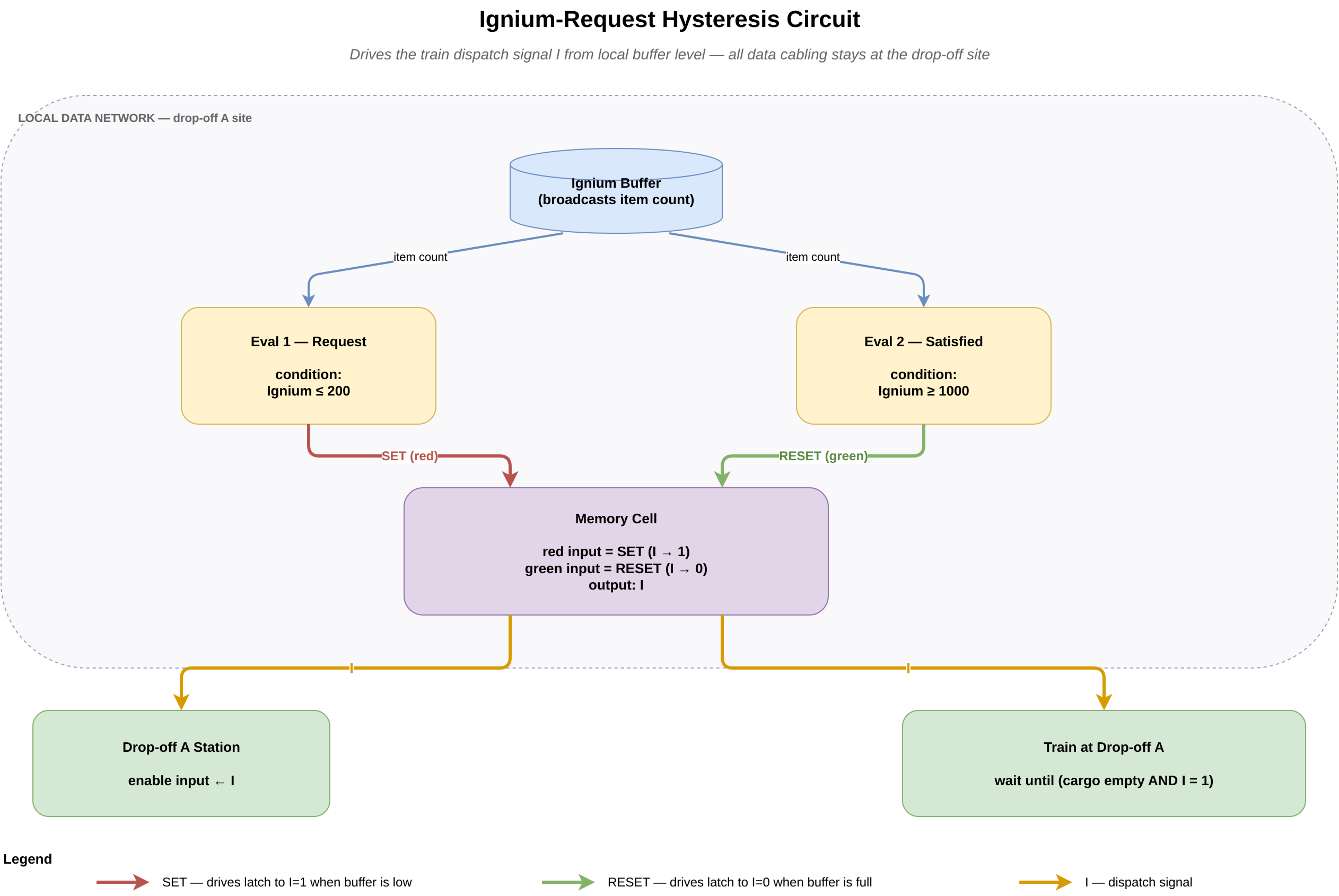
Local data-cable circuit that drives a train dispatch signal I from a buffer's item count. Three components, all sited at the drop-off — no long-distance cabling.

What it does
Produces a single boolean signal I that's 1 when the drop-off buffer genuinely needs more Ignium, and 0 when it's been topped up. That signal feeds two things:
- The drop-off station's enable input — so the station only accepts a train when needed.
- The train's wait condition at the drop-off —
cargo empty AND I = 1— so the train sits at the drop-off and only departs to the pickup when demand is real.
Why two thresholds, not one
A single threshold would chatter: the train arrives, dumps a couple of crates, the count crosses the line, the signal drops, and the train leaves half-full. The hysteresis band — low threshold sets the request, high threshold clears it — gives a clean window where the latch holds state.
Components
| Part | Configuration | Wired to |
|---|---|---|
| Eval 1 — Request | condition: Ignium ≤ 200 |
SET Memory Cell red input |
| Eval 2 — Satisfied | condition: Ignium ≥ 1000 |
RESET Memory Cell green input |
| Memory Cell | SR latch — set goes high, reset clears | output I → station enable + train wait condition |
Polarity flip vs the conveyor circuit
This is the same three-component pattern as the storage-conveyor circuit at /foundry — the only difference is which evaluator drives which memory input.
| Circuit | Eval fires when… | Goes to memory input | Latch behaviour |
|---|---|---|---|
| Conveyor stop | buffer HIGH (Eval 2: full → stop) | SET red | output HIGH = "stop the belt" |
| Train request (this one) | buffer LOW (Eval 1: empty → fetch) | SET red | output HIGH = "send a train" |
The output polarity is the same — but the meaning is inverted because we want HIGH on low buffer, not on full buffer. So the low-threshold evaluator drives set instead of the high-threshold one.
Picking thresholds
- X_low = a bit more than
consumption_rate × train_round_trip_time— so the buffer doesn't run dry before the train returns. - X_high = far enough above X_low that a single train delivery doesn't push the buffer all the way across the band on its own. Typically
X_low + 0.7–0.9 × train_cargo_capacity.
Example: consumer eats 5/sec, round-trip is ~60s → X_low ≈ 350. Train cargo is ~1000 → X_high ≈ 1100.
Where it sits in the wider system
This circuit is the local "brain" for one drop-off site in the dedicated-train pattern: every consumer has its own drop-off + train + this circuit, all co-located. No data cables ever leave the drop-off site. The pickup station stays dumb — it just loads whichever train turns up.